Call to get started: (843) 510-5110
The ShawnLawn Integrated Turf Management Sheets -ITM-
ITM Sheet 1: The Soil Foundation
ITM SHEET 2: AERATION & PHYSICAL REMEDIATION
ITM SHEET 2: AERATION & PHYSICAL REMEDIATION

THE FOUNDATION – SOIL MANAGEMENT (ITM)
ShawnLawn Professional Series: High-Performance Turf Systems
In Integrated Turf Management (ITM), the soil is the "engine room." If the engine isn't tuned, the grass won't perform. For ShawnLawn by SHAYS, LLC, we break soil down into the Triple-Threat Framework: Physical, Chemical, and Biological.
I. Physical Soil Architecture
The physical structure determines the "pore space" available for oxygen and water—the two things roots crave most.
- Soil Texture: Most South Carolina soils lean toward heavy clay or fine sand. For elite turf, we aim for a Sandy Loam profile to balance drainage with nutrient retention.
- Compaction Relief: High-traffic areas suffer from "crushed" pore space.
- The ShawnLawn Standard: Annual or bi-annual Core Aeration to pull 3-inch plugs, allowing the soil to "breathe" and reducing sub-surface resistance.
- Infiltration Rate: This is how fast water moves from the surface to the roots.
II. Chemical Balance & Nutrient Availability
This is where the science happens. We don't guess; we test.
1. The pH Gatekeeper
Soil pH dictates whether your fertilizer actually works.
- Target Range: 6.0 \text{ to } 7.0 for most southern turfgrasses.
- The Issue: If your pH drops below 5.5, Phosphorus and Magnesium become chemically "locked," and no amount of fertilizer will green up the lawn.
2. Cation Exchange Capacity (CEC)
Think of CEC as the "Battery Capacity" of your soil.
- High CEC (Clay/Organic): Holds nutrients well but can be hard to adjust.
- Low CEC (Sand): Nutrients leach out quickly; requires smaller, more frequent "spoon-feeding" of fertilizer.
3. Base Saturation
We monitor the balance of Calcium (Ca), Magnesium (Mg), and Potassium (K). A balanced base saturation ensures the soil structure stays flocculated (loose) rather than dispersed (tight).
III. Biological Vitality (The Living Soil)
A sterile soil is a dead soil. We manage the microbiome to fight disease naturally.
- Organic Matter (OM): We target 3\% \text{ to } 5\% OM. This acts as a sponge for water and a buffet for beneficial microbes.
- Thatch Management: We keep the organic layer under 0.5 inches. Excessive thatch creates a "barrier" that prevents water from reaching the soil and provides a home for pests.
- Microbial Diversity: Healthy populations of mycorrhizae fungi extend the reach of grass roots, helping ShawnLawn turf survive North Charleston heat waves.
ITM SHEET 2: AERATION & PHYSICAL REMEDIATION
ITM SHEET 2: AERATION & PHYSICAL REMEDIATION
ITM SHEET 2: AERATION & PHYSICAL REMEDIATION
The ShawnLawn Standard: Relieving Compaction & Managing Thatch
In Integrated Turf Management (ITM), aeration is the "Lungs" of the lawn. For SHAYS, LLC, we prioritize physical soil health to ensure deep root penetration and nutrient uptake.
1. THE CORE METHOD
The Process: Mechanical Core Aeration. We remove 2.5 to 3-inch soil "plugs" to create physical voids.
The Goal: Reduce bulk density. This restores Pore Space, allowing oxygen to reach the roots and carbon dioxide to escape.
The Result: Enhanced water infiltration and a direct path for fertilizer to reach the root zone.
2. THATCH MANAGEMENT
The Layer: Thatch is the organic mat of stems and roots between the green blades and the soil surface.
The ShawnLawn Limit: Keep it < 0.5 inch.
Excessive Thatch: Acts as a waterproof "umbrella," breeding ground for Pests (Sheet 4), and a nursery for Disease (Sheet 6).
The Remedy: Regular aeration physically breaks up this mat, accelerating natural decomposition.
3. TIMING & FREQUENCY
Warm-Season (Bermuda/Zoysia/St. Augustine): Aerate during peak growth—Late Spring through Early Summer.
Cool-Season (Fescue): Aerate and Overseed during the Fall recovery window.
Frequency: High-traffic North Charleston lawns require 1–2 sessions per year to combat heavy clay compactionIn Integrated Turf Management (ITM), aeration is the "Lungs" of the lawn. For SHAYS, LLC, we prioritize physical soil health to ensure deep root penetration and nutrient uptake.
1. THE CORE METHOD
The Process: Mechanical Core Aeration. We remove 2.5 to 3-inch soil "plugs" to create physical voids.
The Goal: Reduce bulk density. This restores Pore Space, allowing oxygen to reach the roots and carbon dioxide to escape.
The Result: Enhanced water infiltration and a direct path for fertilizer to reach the root zone.
2. THATCH MANAGEMENT
The Layer: Thatch is the organic mat of stems and roots between the green blades and the soil surface.
The ShawnLawn Limit: Keep it < 0.5 inch.
Excessive Thatch: Acts as a waterproof "umbrella," breeding ground for Pests (Sheet 4), and a nursery for Disease (Sheet 6).
The Remedy: Regular aeration physically breaks up this mat, accelerating natural decomposition.
3. TIMING & FREQUENCY
Warm-Season (Bermuda/Zoysia/St. Augustine): Aerate during peak growth—Late Spring through Early Summer.
Cool-Season (Fescue): Aerate and Overseed during the Fall recovery window.
Frequency: High-traffic North Charleston lawns require 1–2 sessions per year to combat heavy clay compaction.
ITM SHEET 3: NUTRIENT MANAGEMENT
ITM SHEET 2: AERATION & PHYSICAL REMEDIATION
ITM SHEET 4: INTEGRATED PEST MANAGEMENT (IPM
The ShawnLawn Fuel: Precision Nutrition & Growth Control
In Integrated Turf Management (ITM), we feed for Root Strength and Stress Resistance, not just for green color. For SHAYS, LLC, we use the Soil Test (Sheet 1) as our GPS.
1. THE BIG THREE (MACRONUTRIENTS)
Nitrogen (N): The "Gas." Drives chlorophyll production and leaf growth.
ShawnLawn Standard: Use Slow-Release Nitrogen to provide a steady "spoon-fed" green rather than a growth spike that invites disease.
Phosphorus (P): The "Foundation." Essential for root development and energy transfer.
Note: Often restricted in SC unless establishing new turf; check soil levels first.
Potassium (K): The "Shield." Regulates water movement and cell wall thickness.
Crucial for: Heat tolerance in Summer and cold hardiness in Winter.
2. THE MICRONUTRIENT "POP"
Iron (Fe): Provides a deep, "Blue-Green" ShawnLawn tint without causing the grass to grow uncontrollably.
Magnesium (Mg): The center of the chlorophyll molecule. Without it, the "engine" can't run.
Manganese (Mn): Vital for photosynthesis and defending against root-infecting fungi like Take-All Root Rot.
3. CALIBRATION & APPLICATION
Analysis over Assumptions: We apply based on lbs of N per 1,000 sq ft.
Granular vs. Liquid: * Granular: Long-term stability and slow release.
Liquid: Fast-acting foliar absorption for precise "color-ups" and micro-dosing.
Environmental Safety: We maintain a 3-foot "No-Fly Zone" (buffer) near water edges and storm drains to protect the North Charleston ecosystem.
ITM SHEET 4: INTEGRATED PEST MANAGEMENT (IPM
ITM SHEET 4: INTEGRATED PEST MANAGEMENT (IPM
ITM SHEET 4: INTEGRATED PEST MANAGEMENT (IPM
In Integrated Turf Management (ITM), we don’t eliminate all insects—we manage the ones that cause damage. For SHAYS, LLC, we use the "Scout First" method to keep the North Charleston ecosystem balanced.
1. SURFACE FEEDERS (THE GRAZERS)
The Culprits: Armyworms, Sod Webworms, and Chinch Bugs.
The Damage: These pests eat the leaf blades or suck the "juice" out of the plant, leading to rapid browning.
ShawnLawn Scouting: Look for "notched" grass blades or increased bird activity on the lawn.
The Soap Flush: We use a mixture of water and lemon dish soap to force larvae to the surface for identification.
2. SUB-SURFACE FEEDERS (THE ROOT DESTROYERS)
The Culprits: White Grubs (Beetle larvae) and Mole Crickets.
The Damage: They tunnel through the soil and devour the root system.
The Sign: "Spongy" feeling soil or turf that peels back like a carpet because there are no roots left to hold it down.
ShawnLawn Standard: We target the "Egg-Lay" window (usually early Summer) to stop the next generation before they hatch.
3. THE THRESHOLD PHILOSOPHY
The Rule: We only treat when the pest count exceeds the Economic Threshold.
Example: 1-2 grubs per square foot is normal. 6-10 grubs per square foot requires a ShawnLawn intervention.
Beneficials: We protect "Good Bugs" like Ladybugs, Big-Eyed Bugs, and Spiders that provide free pest control for your propertyThe ShawnLawn Shield: Scouting, Thresholds, & Targeted Control
In Integrated Turf Management (ITM), we don’t eliminate all insects—we manage the ones that cause damage. For SHAYS, LLC, we use the "Scout First" method to keep the North Charleston ecosystem balanced.
1. SURFACE FEEDERS (THE GRAZERS)
The Culprits: Armyworms, Sod Webworms, and Chinch Bugs.
The Damage: These pests eat the leaf blades or suck the "juice" out of the plant, leading to rapid browning.
ShawnLawn Scouting: Look for "notched" grass blades or increased bird activity on the lawn.
The Soap Flush: We use a mixture of water and lemon dish soap to force larvae to the surface for identification.
2. SUB-SURFACE FEEDERS (THE ROOT DESTROYERS)
The Culprits: White Grubs (Beetle larvae) and Mole Crickets.
The Damage: They tunnel through the soil and devour the root system.
The Sign: "Spongy" feeling soil or turf that peels back like a carpet because there are no roots left to hold it down.
ShawnLawn Standard: We target the "Egg-Lay" window (usually early Summer) to stop the next generation before they hatch.
3. THE THRESHOLD PHILOSOPHY
The Rule: We only treat when the pest count exceeds the Economic Threshold.
Example: 1-2 grubs per square foot is normal. 6-10 grubs per square foot requires a ShawnLawn intervention.
Beneficials: We protect "Good Bugs" like Ladybugs, Big-Eyed Bugs, and Spiders that provide free pest control for your property.
Lawn Mowing and Trimming
ITM SHEET 4: INTEGRATED PEST MANAGEMENT (IPM
Lawn Mowing and Trimming
Our lawn mowing and trimming service keeps your lawn looking neat and tidy. We use professional-grade equipment to ensure a clean, even cut that promotes healthy growth.
Leaf Removal and Cleanup
ITM SHEET 4: INTEGRATED PEST MANAGEMENT (IPM
Lawn Mowing and Trimming
Our leaf removal and cleanup service keeps your lawn looking its best during the fall season. We use professional-grade equipment to quickly and efficiently remove leaves and other debris from your lawn.
In-Depth Lawn Health Analysis
Tailored Fertilization for Thriving Grass
Promote Growth with Lawn Aeration
Our lawn analysis service delivers a comprehensive evaluation of your lawn's current health. We assess soil composition, nutrient levels, and pH to create an actionable plan for improvement. With our expertise, we can help you restore your lawn to its full potential, ensuring lush growth and vibrant color.
Promote Growth with Lawn Aeration
Tailored Fertilization for Thriving Grass
Promote Growth with Lawn Aeration
Our lawn aeration service is designed to enhance your lawn's health by allowing better air and water penetration. By creating small holes in the soil, we promote deeper root growth and improve overall lawn vitality. Experience the benefits of aeration and watch your lawn thrive under our care.
Tailored Fertilization for Thriving Grass
Tailored Fertilization for Thriving Grass
Tailored Fertilization for Thriving Grass
Our lawn fertilization service uses premium organic fertilizers that cater to your lawn's specific needs. We customize our fertilization programs to ensure your grass receives the right nutrients for optimal growth and development. Trust our team to help you achieve a lush and healthy lawn that enhances your outdoor space.
Tailored Fertilization for Thriving Grass
ITM SHEET 5: HYDRATION & IRRIGATION
ITM SHEET 5: HYDRATION & IRRIGATION
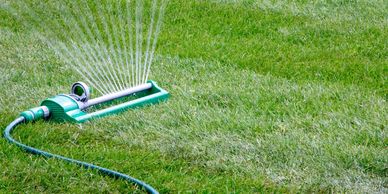
The ShawnLawn Flow: Deep Roots & Water Efficiency
In Integrated Turf Management (ITM), water is a delivery system, not just a drink. For SHAYS, LLC, we move away from "daily misting" toward Deep and Infrequent cycles that force roots to hunt for moisture.
1. THE DEEP & INFREQUENT RULE
The Goal: Apply 1 to 1.5 inches of water per week.
The Frequency: Instead of 10 minutes every day, we do 45–60 minutes, twice a week.
The Result: This saturates the entire root zone. As the surface dries, the roots are forced to grow deeper into the soil (Sheet 1) to find the remaining water, making the lawn drought-resistant.
2. AUDITING & CALIBRATION
Head-to-Head Coverage: Every sprinkler head must reach the base of the next head. "Gap-to-gap" coverage creates dry spots and localized stress.
The Tuna Can Test: Place containers across the lawn to measure actual output. If one area gets 0.5 inches and another gets 0.1, the system is out of balance.
Distribution Uniformity (DU): We optimize nozzles to ensure the water is applied evenly, preventing "wet feet" (fungus) in one spot and "crispy" grass in another.
3. TIMING (THE "DEW POINT" WINDOW)
The Best Time: 4:00 AM to 8:00 AM.
Why: Minimal wind (less evaporation) and lower water demand on the city grid.
The Danger Zone: Watering at night (8:00 PM to 12:00 AM).
Why: Leaving grass blades wet for 10+ hours creates a "Petri dish" for fungal diseases like Large Patch or Grey Leaf Spot.